Buc-ee’s: The Gas Station That Became a Texas Destination

A friend from Oregon recently came to Dallas for the first time. When I asked what he most wanted to see in Texas, I expected him to mention Downtown Dallas, the Fort Worth Stockyards, AT&T Stadium, or a famous barbecue restaurant.
Instead, he answered immediately: “Buc-ee’s.”
I asked, “You mean the gas station?”
“Yes,” he said. “That is the first place I want to visit.”
What surprised me was not only his answer, but how normal it sounded to everyone else. For many Americans, especially those familiar with Texas road trips, stopping at Buc-ee’s is not simply a practical break. It is part of the experience.
That raises an interesting question: how did a highway gas station become a tourist destination? The answer is not just clean restrooms, brisket sandwiches, beef jerky, or a memorable beaver logo. Buc-ee’s succeeded because it combined customer psychology, operational discipline, branding, and commercial real estate into one highly repeatable system.
More Than a Gas Station
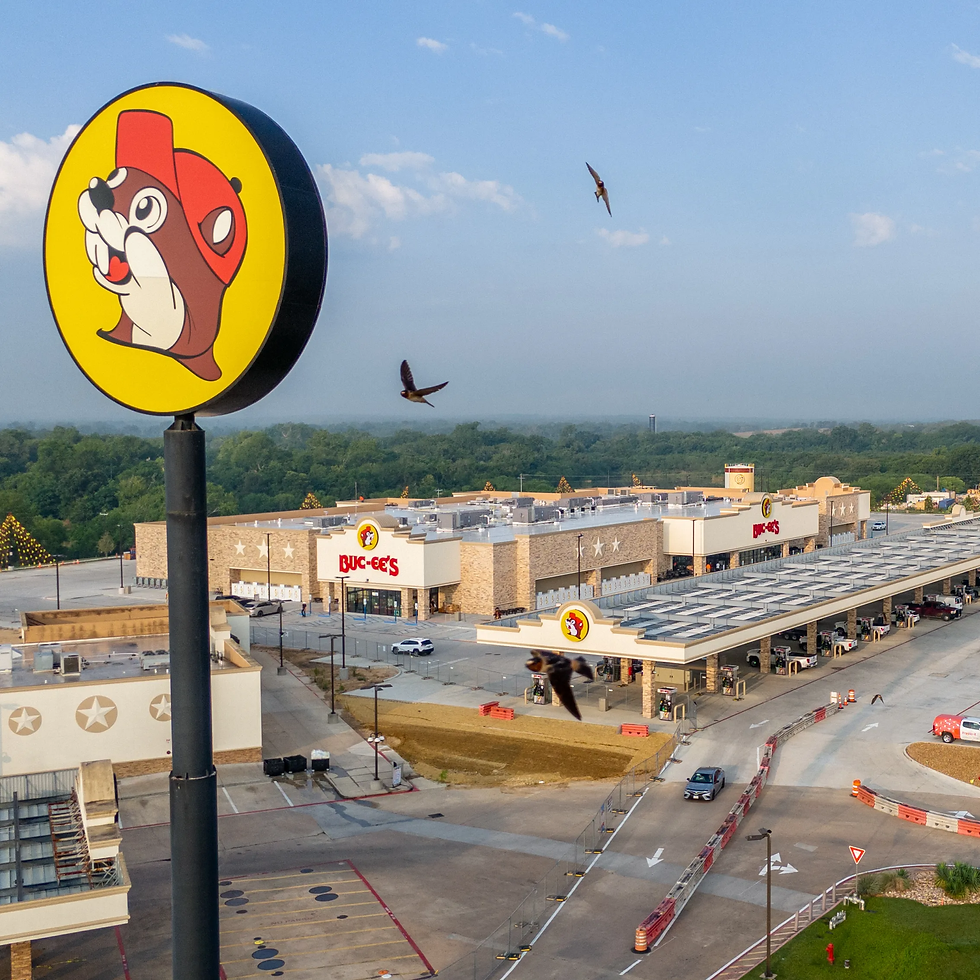
Buc-ee’s was founded in Texas in 1982. Over time, it developed a new type of highway travel center: enormous stores, large numbers of fuel pumps, extensive food options, branded merchandise, and a highly controlled customer experience.
A traditional gas station is designed around necessity. Drivers stop because they need fuel, use the restroom, and leave as quickly as possible.
Buc-ee’s changed that behavior. Customers often stop even when they do not urgently need gas. Families enter the store together, browse the jerky wall, watch brisket being prepared, buy snacks and souvenirs, and take photos with the Buc-ee’s beaver.
The company turned a functional stop into a destination.
It also turned Texas culture into a retail product. The oversized store, barbecue, road-trip atmosphere, bright signage, and beaver merchandise create a recognizable experience that customers associate with Texas itself.
When people are willing to wear a gas station’s logo on a shirt, the business is no longer selling only fuel and food. It is selling identity and memory.
The Restroom as a Customer-Acquisition Strategy
One of Buc-ee’s smartest decisions was to focus on a problem most gas stations treated as an afterthought: restroom cleanliness.
For highway travelers, especially families, a clean and reliable restroom can determine where they stop. Buc-ee’s made cleanliness a core brand promise rather than a basic operating requirement.
That promise creates trust. A driver may pass several other gas stations because Buc-ee’s offers greater certainty: clean restrooms, available pumps, food choices, and a predictable experience.
Once customers enter the store, the business has multiple opportunities to generate revenue. Someone who planned to use the restroom may also buy coffee, snacks, brisket, beef jerky, or merchandise.
In this sense, the restroom is not merely a customer service feature. It is the top of the sales funnel.
Buc-ee’s also designed its locations for both speed and spending. Large numbers of fuel pumps reduce waiting times, multiple registers improve customer flow, and extensive product selection increases the chance that every person in the vehicle will buy something.
The goal is not to keep customers inside for hours. The goal is to maximize the value of each stop while keeping traffic moving efficiently.
The Real Moat Is Real Estate
Buc-ee’s may look like a retail company, but much of its competitive advantage is rooted in commercial real estate.
A typical convenience store can operate on a small corner lot. A large Buc-ee’s location requires substantial acreage, highway visibility, convenient access, multiple entrances and exits, parking, fuel infrastructure, and carefully planned traffic circulation.
The building is only one part of the investment. The full product is the site itself.
Traditional retailers often evaluate the population and income within a one-, three-, or five-mile radius. Buc-ee’s operates differently because its customers are moving.
Its trade area is the highway.
The company serves drivers traveling between major cities, suburban communities, tourist destinations, and neighboring states. These customers may live hundreds of miles away, but they make a purchasing decision at one specific exit. For Buc-ee’s, traffic volume functions like population, and the highway exit functions like the front door.
That means site selection requires a long-term view. The company must evaluate not only current traffic, but also future population growth, suburban expansion, tourism, industrial development, road capacity, and regional travel patterns.
Texas was an ideal environment for this model because of its large distances, car-dependent lifestyle, growing metropolitan areas, and strong highway connections between Dallas, Houston, Austin, and San Antonio.
In the Dallas-Fort Worth area, Buc-ee’s locations illustrate this strategy clearly. They are not placed in the most expensive urban intersections. They are positioned along major transportation corridors where regional travel and suburban growth intersect.
A site far from downtown can still be extremely valuable if it controls the right flow of traffic.
Why Buc-ee’s Is Difficult to Copy
The visible parts of Buc-ee’s are easy to imitate. A competitor can improve restroom cleanliness, sell barbecue, expand its snack selection, or create a friendly animal mascot.
What is difficult to copy is the entire system.
Buc-ee’s combines large-scale real estate investment, highway access, traffic engineering, food operations, employee management, brand consistency, and customer trust. Each part supports the others.
The brand attracts traffic. The site can handle the traffic. The store converts traffic into purchases. The operating system keeps the experience consistent.
This is why Buc-ee’s does not need to be a traditional shopping center anchor tenant to influence surrounding real estate. In many locations, the store itself becomes a regional traffic generator and helps redefine the commercial value of a highway exit.
Its moat is not one product or one marketing campaign. Its moat is a business model that only works when placed on the right land.
A Commercial Real Estate Lesson on the Highway
When I eventually took my Oregon friend to Buc-ee’s, he took a photo with the beaver, studied the jerky selection, and ate a brisket sandwich as if he had completed an important part of his Texas trip.
That was when I understood that he had never wanted to visit a gas station.
He wanted to experience a Texas road-trip ritual.
Buc-ee’s succeeded because it understood what travelers feel and need during a long drive, then translated those needs into a trusted brand and a profitable real estate model.
Its story offers a useful commercial real estate lesson: the value of a property is not determined only by what is built there. It is also determined by who passes the site, why they are willing to stop, and whether the location can convert movement into long-term economic value.
That is the real Buc-ee’s story: a Texas retail legend built on highways, customer behavior, and strategic land.
Comments